

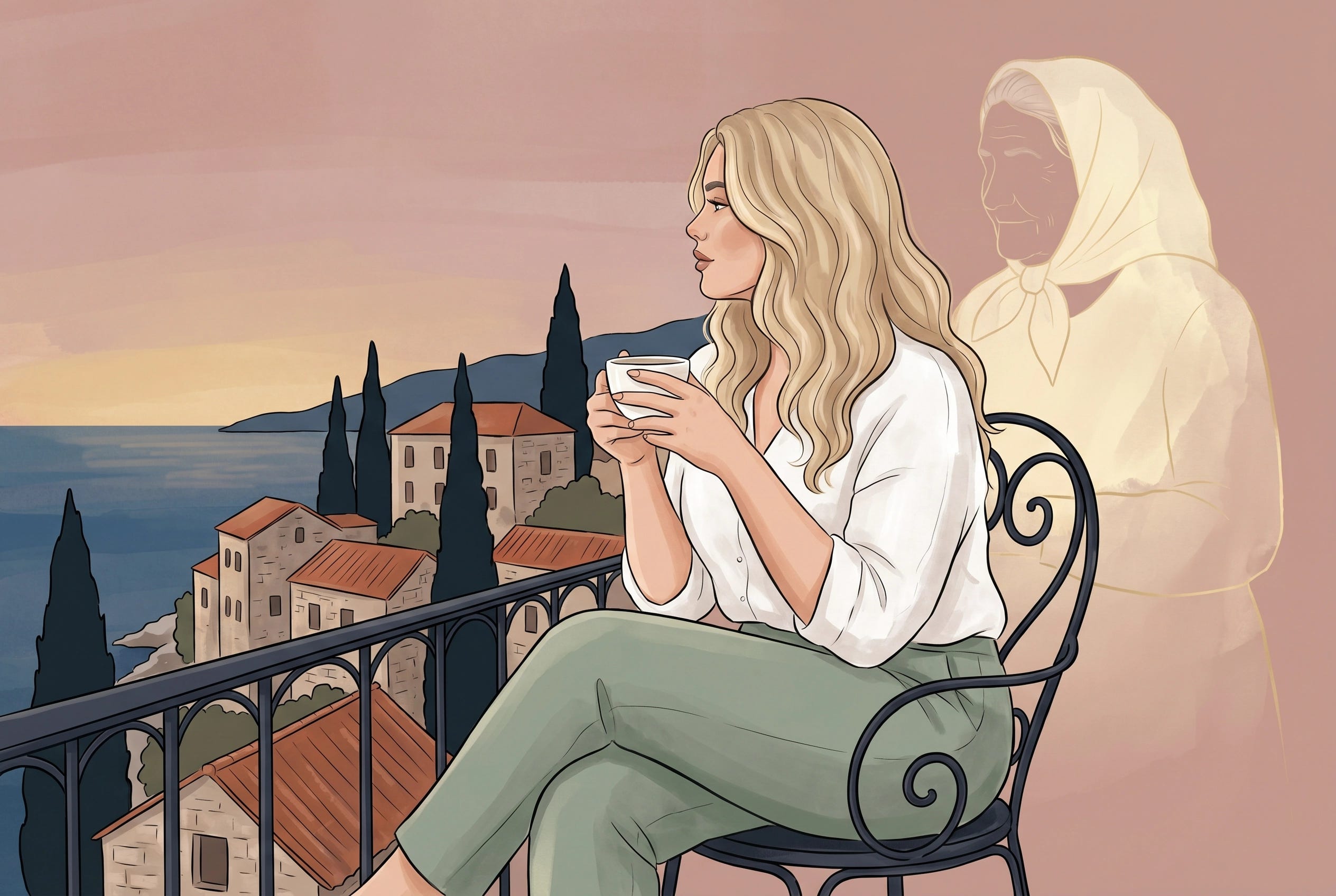
I need to tell you about my baka.
Not because this is a nostalgia piece. Not because grandmothers are trending on Substack. But because last Wednesday at 11 PM, while I was rewriting the same Instagram caption for the fourth time — with a cup of coffee that had gone cold an hour ago, because apparently I’m the kind of person who makes coffee and then forgets to drink it — she walked into my head uninvited.
The way she used to walk into our kitchen. Without knocking. Carrying a pot of something that smelled like home.
She said — well, she didn’t say anything. She passed in 2016, at 93, with an opinion about everything until the very last day. But I heard her voice as clearly as if she were standing behind me:
“Zašto se pretvaraš da si netko drugi?”
Why are you pretending to be someone else?
I closed my laptop. I didn’t rewrite the caption. I sat in the dark for twenty minutes.
And that’s when something cracked open.
The Immigrant Daughter’s Content Problem
Here’s something I’ve never written about publicly, because it felt too personal for a “business” newsletter. But I’m done pretending this is just a business newsletter.
I grew up between two worlds. My parents came from Croatia to Germany in the 1970s — my tata from a tiny village called Pandore, up in the Velebit mountains near Senj, and my mama from a small village near Slunj. They brought everything with them: the language, the food, the humor, the stubbornness, the belief that hard work fixes everything and feelings are best discussed never.
And I grew up learning to translate. Not just languages — I speak several — but worlds. At school, I was the Croatian kid. At home, I was the quiet one — I have three sisters, and I was the one my mama could sit on the couch with the words “Ne mrdaj” — don’t move — and I wouldn’t move. Apparently, I didn’t even blink. In Croatia, visiting family in the summers, my sisters and I were Švabice — the German ones. Not quite Croatian enough there. Not quite German enough here.
And online? Online, I was... what, exactly?
That’s the question that hit me at 11 PM.
Because somewhere along the way, I had created yet another version of myself for the internet. A version that was polished and strategic and used words like “framework” and “leverage” and “content pillar.” A version that sounded like every other creator writing about AI and branding.
A version my baka would not have recognized. A version that would have made her walk into my office, look at my screen, and say something devastating in three words — the way only Balkan grandmothers can.
The Three Languages in My Head
I want to try something with you. I want to show you how I actually think — not the cleaned-up version, but the real one.
When I’m working on a brand strategy for a client, I think in English. It’s structured. It’s precise. “Define the core value proposition. Identify the visual language. Build the messaging hierarchy.” Clean. Professional. Useful.
When I’m feeling something — really feeling it, not just thinking about feeling it — I switch to Croatian. There’s a word, čežnja, that means something between longing and homesickness and the ache you feel when you miss someone who’s sitting right next to you. English doesn’t have that word. German has Sehnsucht, which is close but not quite. Croatian has čežnja, and when I feel it, that’s the language it arrives in.
And when I’m being funny — the dry, deadpan, “everything is fine while the house is burning” kind of funny — that’s pure Balkan. That’s the humor I grew up with. The humor of Lepa Brena movies and Audicija and my uncle telling the most devastating story you’ve ever heard with a completely straight face and then asking if anyone wants more rakija. My tata’s village, Pandore — let’s just say it could have easily been called Pijandore. Rakija for breakfast wasn’t a joke there. It was Tuesday.
Three languages. Three versions of me. And my content has been using exactly one of them.
The Experiment
So I tried something stupid. Or brave. I’m not sure which — on the Balkan, those are often the same thing.
I wrote a Substack Note the way I’d actually tell the story to a friend. Not my “content creator” voice. My real voice. The one that switches languages mid-sentence. The one that makes a joke when things get too serious. The one that references my grandmother and Croatian villages in the same breath as AI tools.
I didn’t plan it. I didn’t outline it. I didn’t run it through any framework.
I just... talked. On paper.
And here’s what happened: More people responded to that one unplanned Note than to my last three carefully structured articles combined.
I sat there looking at the notifications and thought about my tata. He passed in 2014, but his voice still lives in my head rent-free. He was a man of few words — the kind who could end an entire argument with one look. When things worked out unexpectedly, he’d just say: “Vidiš?” See? That was it. No explanation. No “I told you so.” Just vidiš, with a shrug, like the answer had been obvious all along and you were the only one who couldn’t see it.
He was also the kind of man who once told me: “Ne odmah, nego sad!” — Not right away, but NOW. I still don’t know what the difference is. Odmah and sad literally mean the same thing. But when he said it, you didn’t ask questions. You moved.
I think about that a lot when it comes to content. We spend so much time planning to be authentic odmah — soon, eventually, when we’re ready. Maybe the answer is sad. Now. Even if it’s messy.
What I Actually Learned (The Un-Framework)
I’m not going to give you “5 Steps to Finding Your Authentic Voice.” If I’ve learned anything from this experience, it’s that the moment you turn authenticity into a framework, it stops being authentic.
But I will tell you what I noticed. Not as a strategy. As a confession.
The parts of me I was hiding were the parts people wanted to see. The Croatian references. The dry humor. The spirituality. The fact that I sometimes pull a Tarot card before making a business decision — yes, really, and no, I’m not going to apologize for it. These weren’t “unprofessional.” They were the only things that made my content different from the 47,000 other people writing about AI and branding.
My “messy” voice performed better than my “clean” voice. Not because messy is better. But because messy was mine. The clean voice was a composite of every creator I’d been reading for six months. Professional, yes. Mine? Ne. Not even close.
The bilingual thing isn’t a bug. For years, I treated my multilingual brain as something to manage — make sure the English is perfect, don’t let the German structures sneak in, definitely don’t drop Croatian words into a business article. But that mixing? That’s exactly what makes my perspective different. I see patterns between cultures that monolingual creators can’t see. I make connections between a Croatian proverb and a branding principle that nobody else would make. That’s not confusion. That’s range.
The Uncomfortable Truth About “Finding Your Voice”
Everyone says “find your voice” like it’s a treasure hunt. Like your voice is hiding somewhere and you just need the right map.
But what if your voice isn’t lost? What if it’s right there — in the way you talk to your best friend over coffee at midnight, in the stories you tell at family dinners, in the jokes that make your people laugh — and the only reason it’s not in your content is because you decided it wasn’t “professional” enough?
I spent months trying to sound like the creators I admired. And they’re brilliant — truly. But I’m not them. I’m the daughter of Croatian immigrants who writes romance novels and pulls Tarot cards and makes brand strategies that somehow work, and I do all of this while switching between three languages in my head like a radio that can’t find the right station.
That’s not a problem to fix. That’s a voice to use.
My mama used to sit me on the couch and say “Ne mrdaj.” Don’t move. And I didn’t. I was the quiet one. The observer. The one who watched everything and said nothing. Apparently, I didn’t even blink.
Turns out, that’s exactly the skill that makes me good at what I do now. I watch. I notice. I see the thing nobody else sees. And then — when I finally speak — it means something.
I just forgot to bring that into my content.
What Changes Now
I’m not going to promise you that every article from now on will be perfect. I’m not even sure what “perfect” means anymore — probably something a LinkedIn guru made up to sell a course.
But I am going to promise you this: it’ll be me. The real one. The one with the accent you can hear even in writing. The one who makes a čežnja reference in a business article and doesn’t explain it because some things are better felt than translated.
If that’s not for you, I understand. There are plenty of clean, polished, framework-heavy newsletters out there.
But if you’ve ever felt like you’re performing a version of yourself online that your grandmother wouldn’t recognize — onda si na pravom mjestu.
Then you’re in the right place.
See you next time,
Anita
BabicADesigns — Where soul meets system.
P.S. — Next in the Creator System Series: how I’m actually using AI to amplify my real voice instead of replacing it. Spoiler: it involves talking to Manus the way I’d talk to a friend, not the way I’d write a brief. Turns out, AI is better at helping you sound like yourself when you stop trying to sound like everyone else.
The Soulful Tip Jar 🧡
My Substack will always remain free to read. But if this article gave you a little "aha" moment or made you smile today, or if you just want to support my work without committing to a subscription, you can leave a little something in my tip jar.