


Grab your kava. This one’s practical. ☕
A few months ago, my brand looked different.
I had visuals I liked. A swan. Clean design. Nothing wrong with it. But something didn’t sit right — it didn’t fully reflect where I was going. The more I wrote, the more Balkan I became. The more I leaned into my roots — the language, the philosophy, the pomalo energy — the more I realized my visual identity hadn’t caught up with my actual identity.
Brands evolve. Mine did too. And last Tuesday, something happened that made it click.
I saw a tool recommended on Instagram. Taste Skill. Saved it, forgot about it, the usual. Then I had a free morning, opened Creao AI, and thought: ajde, let’s try it.
Four hours later I had a complete brand system — logo, color palette, typography, a 10-page guidelines PDF. And a symbol that stopped me when I saw it.
A letter B, built from cross-stitch geometry. The same pattern as traditional Croatian lace. Čipka. My grandmother’s craft. In my logo.
I didn’t ask for it. It came from everything my AI already knew about me.
That’s the part I want to explain properly.
What is Taste Skill?
It’s a free tool that lives on GitHub — a platform where developers share resources publicly. Most of GitHub is for coders. But Taste Skill is different.
It’s what’s called an “anti-slop” framework. You install it into your AI tool — Claude, Manus AI, Creao AI, any agent that accepts custom skills — and it changes how your AI makes decisions. Instead of defaulting to generic output — the beige, the safe, the leaf-in-a-logo — it pushes toward specificity and intention.
In Creao and Manus, installation is simple: you add the skill and the tool immediately suggests what it can do, including a brandkit option. No code. No complicated setup. You pick what you want to build and go.
Find it here: github.com/Leonxlnx/taste-skill — 30.8k people have bookmarked it. That’s not a coincidence.
But here’s what Taste Skill actually needs from you:
The skill is the framework. You are the content.
When I ran the brandkit that morning, Creao AI already knew me well. Not because I’d introduced myself once — but because over weeks of working together, I’d given it real context. My positioning. My audience. What I stand for. What I refuse to be. And most importantly: my brand voice and a complete brand guidelines document.
That’s why the output was specific. That’s why it landed on čipka. The AI made a connection I hadn’t consciously made — because it had enough real information about me to do so.
If you open a fresh AI session tomorrow and run this skill with zero context, you’ll get something generic. Not because the skill doesn’t work. Because the AI has nothing to work with.
So what does “giving your AI context” actually mean?
This is where most people get stuck — and where I want to be practical.
Your AI needs to understand your brand voice. Not your job title. Not your niche keywords. Your actual voice — how you sound, what you believe, who you’re really talking to, what you’d never say even if it performed well.
I wrote about this a few weeks ago: Your Brand Voice Isn’t a Style Choice. It’s an Excavation. That piece explains why most people’s AI content sounds generic — and what’s actually underneath it.
The short version: before you can give your AI good context, you need to excavate your own voice first. That process has a few layers:
Layer 1 — Diagnose the gap. Most people don’t know where their voice is leaking. The AI Voice Gap is a free ten-minute diagnostic that shows you exactly where. It’s the starting point — and it’s free.
Layer 2 — Build the foundation. Once you know what’s missing, you build it. Your Brand DNA. Your Voice System. The one document that lives in every AI session you open — and changes everything that comes out of it. This is what I’m building out properly as a guided workspace. More on that soon.
Layer 3 — Give it to your AI. Store it in Claude, in Manus, in Creao. Every session starts from the same foundation. No more explaining yourself from scratch every time. No more generic output.
That document is what made the čipka B possible. Not the skill alone. The skill + the context together.
The result — and yes, I’m sharing it:
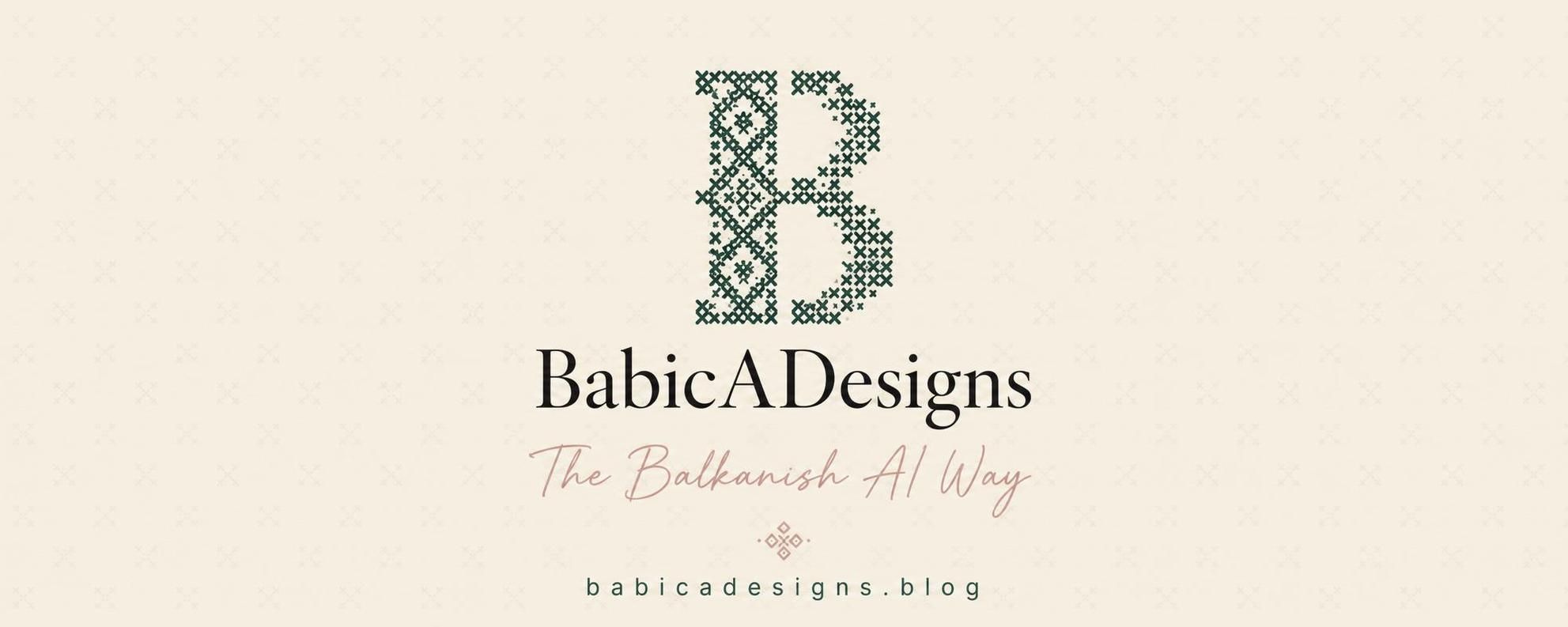
The čipka B. Dark sage green, cross-stitch geometry, a letter built the way lace is built — stitch by stitch, with patience.
My brand finally looks like what I’ve been writing. The Balkanish AI Way — not just as words, but as a visual identity that carries the same heritage.
It took one morning. And weeks of context work before that.
If you want to try this:
Start with your voice. Before any tool, before any skill — your AI needs to know who’s speaking.
I wrote about why that matters here:
It covers the first layer — but only the first. Voice is one piece of a bigger foundation.
I’m currently building a product that walks through the complete process — from brand DNA to voice system to the document your AI actually works from. It’s not ready yet. But it’s coming. If you want to know when it lands, stay on the list.
For now: the
is where to start. Free, ten minutes, no fluff. It shows you exactly what your AI is missing about you.
Build the context. Then run the skill.
Ajde. ✍️
Anita
babicadesigns.blog