


Sunday night. 9 PM. Third coffee. Laptop open. Couch.
This is the moment most creators dread: the blank screen. The “what am I even posting this week” spiral. The one where you open seven tabs, scroll through three apps, screenshot something you’ll never look at again, and end up watching a documentary about octopuses because — well, because your brain needed an escape route.
I used to be that person. Every. Single. Week.
And then I found Manus.
Not in a “this tool changed my life” influencer way. More in a “I accidentally discovered that my AI assistant could do the thing I hated most” kind of way. Like finding out your quiet neighbor is actually a DJ. You didn’t see it coming, but now you can’t unhear it.
What Manus Actually Is (For Those Who Haven’t Met)
Let me back up. Because when I say “Manus,” some of you might think I’m talking about another chatbot. I’m not.
Manus is an AI agent. Not a chatbot that answers questions — an agent that actually does things. It researches. It writes. It plans. It builds. It creates spreadsheets, websites, presentations, social media content. It reads documents. It analyzes data. It remembers what you told it three weeks ago.
Think of it like this: ChatGPT is the friend who gives great advice. Manus is the friend who gives great advice and then actually helps you move apartments on Saturday.
The difference matters. Because as a solopreneur, I don’t just need ideas. I need execution.
How My Content Week Actually Works Now
Let me walk you through what happened this week. Not a theoretical “you could do this” tutorial. What I actually did. Step by step.
Step 1: The Brain Dump (Sunday Evening)
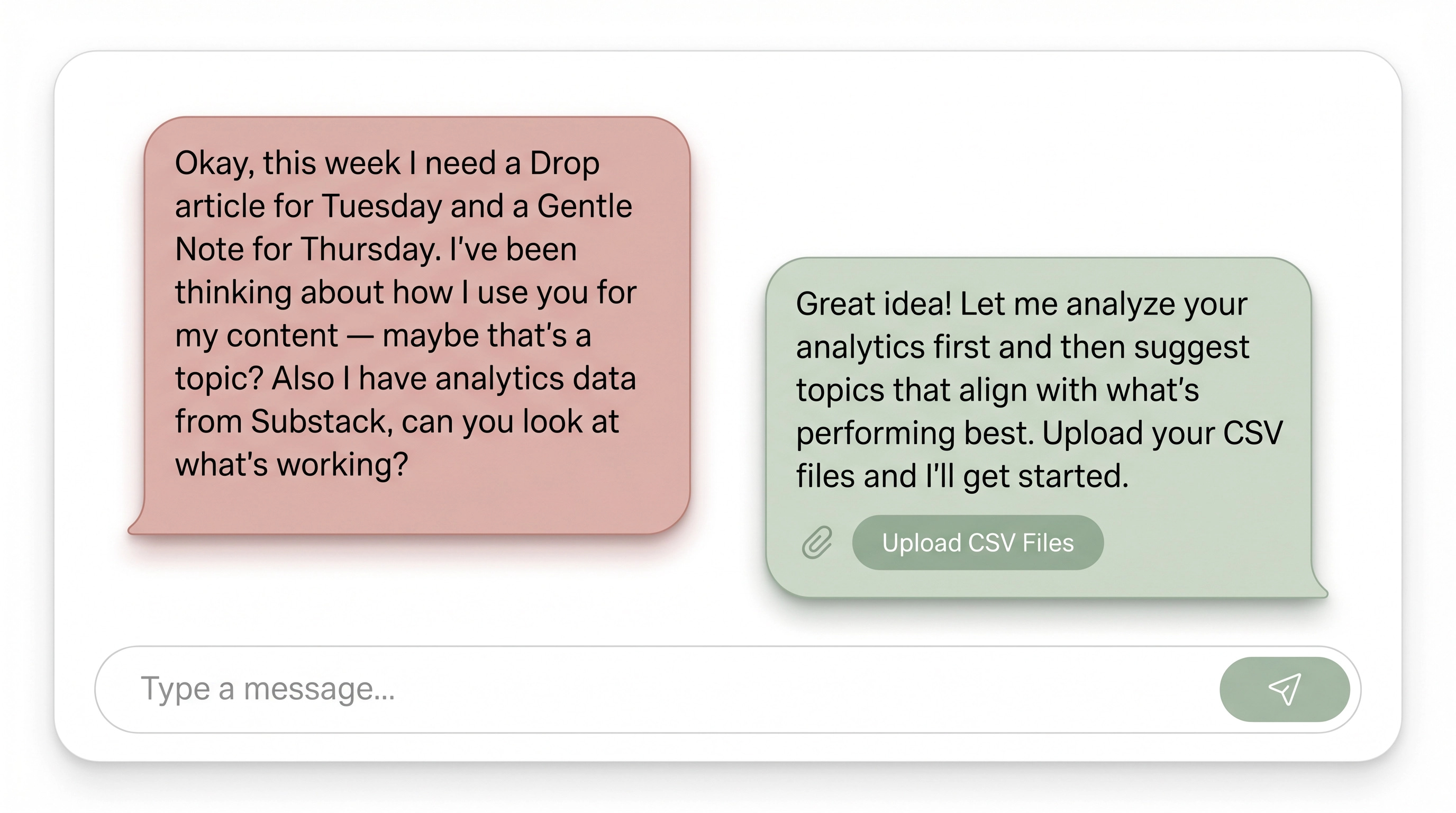
I start by telling Manus what’s on my mind. Not in a structured way. More like texting a friend:
“Okay, this week I need a Drop article for Tuesday and a Gentle Note for Thursday. I’ve been thinking about how I use you for my content — maybe that’s a topic? Also, I have analytics data from Substack, can you look at what’s working? And I need Notes for every day, plus Instagram posts for both articles.”
That’s it. No brief. No project plan. No framework. Just me, talking.
[Screenshot-Stelle: Hier könnte ein Screenshot deines Chats mit Manus hin, wo du die Woche planst]
Step 2: The Research (Manus Does the Heavy Lifting)
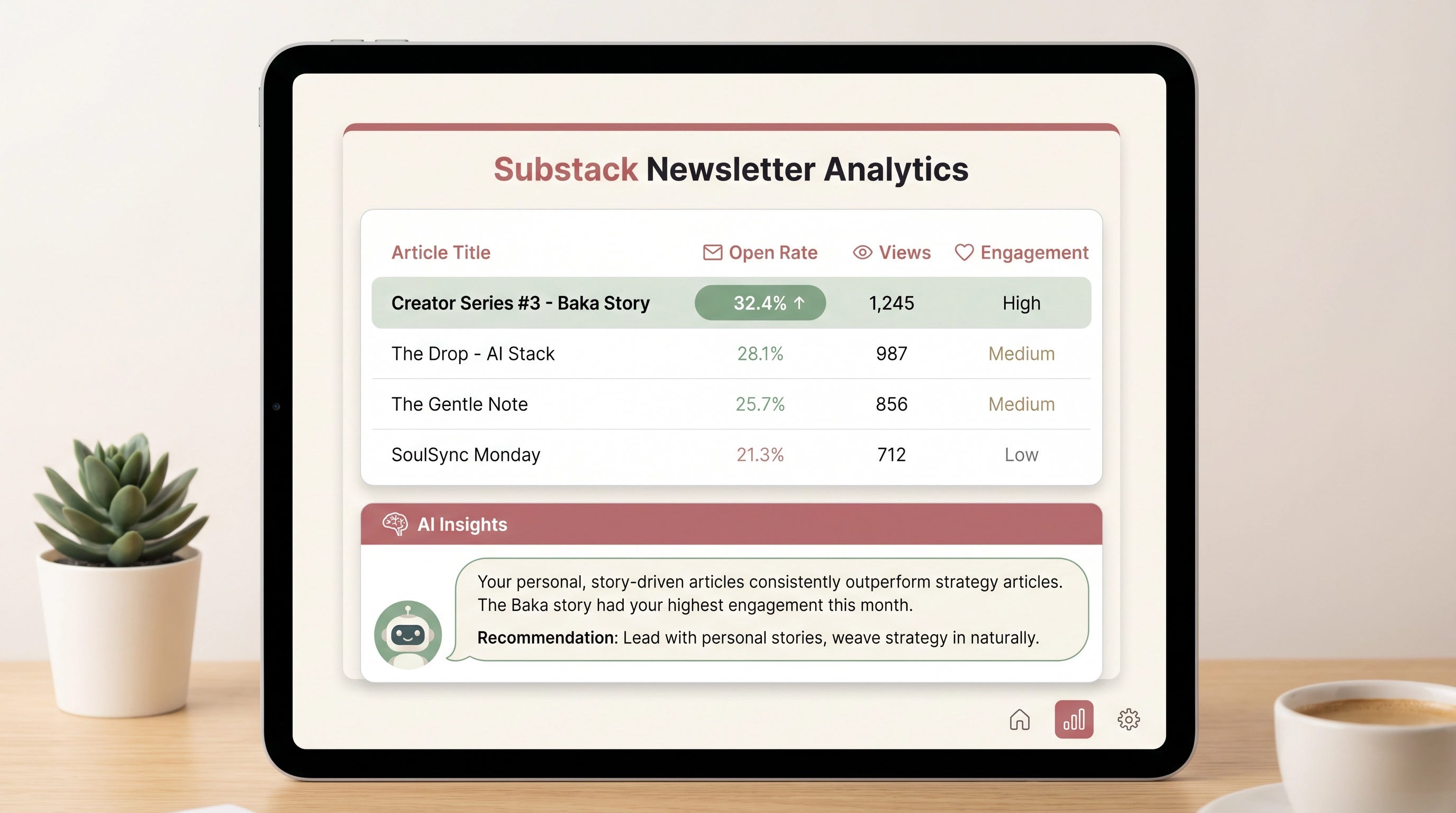
Here’s where it gets interesting. I uploaded my Substack analytics — just the raw CSV files — and asked Manus to analyze them. Within minutes, I had:
•A complete breakdown of which articles performed best (and why)
•Open rates, engagement rates, view trends over time
•A clear diagnosis: my personal, soulful articles consistently outperform my strategy articles
•Specific recommendations for this week’s topics
I didn’t have to build a spreadsheet. I didn’t have to do the math. I didn’t have to pretend I enjoy looking at numbers. (I don’t. I’m a storyteller, not a data analyst. My baka — who passed in 2016 at 93 — would have said: “Nemoj reć hop prije nego što preskočiš.” Don’t celebrate the numbers before you understand what they mean.)
Step 3: The Topic Discussion (This Is Where It Gets Good)
Now, Manus didn’t just hand me a topic and say “write this.” We had a conversation. A real back-and-forth.
Manus suggested three options. I said: “That doesn’t feel right. The Drop is supposed to be practical, like a learning tool. Not a think piece.” And Manus adjusted. Not in a “yes, ma’am” way — in a “okay, I understand the difference now, here’s a better approach” way.
This is the part most people don’t understand about working with AI: it’s a conversation, not a command. You don’t type a prompt and get a perfect result. You talk. You push back. You refine. You say “that’s not me” and the AI learns what is you.
My tata — he passed in 2014, a man of very few words — used to say “Ne odmah, nego sad!” Not right away, but NOW. To this day I have no idea what the difference between odmah and sad is. But with Manus, I kind of get it now: the first answer is odmah — quick, automatic. The real answer comes when you push for sad — the one that’s actually right.
Step 4: The Writing (Together, Not Alone)
Once we agreed on the topic, Manus wrote a first draft. And here’s the honest truth: the first draft is never perfect. It’s about 70% there. The structure is solid. The research is accurate. The flow makes sense.
But the voice? That’s where I come in.
I read through it and add the things only I can add: the coffee at 9 PM, the Balkan humor, the moment where I break a serious point with something dry and unexpected. The Croatian words that don’t translate. The čežnja — that ache between longing and homesickness that English doesn’t have a word for.
Manus gives me the bones. I add the soul.
Step 5: The Social Media Content (The Part I Used to Hate)
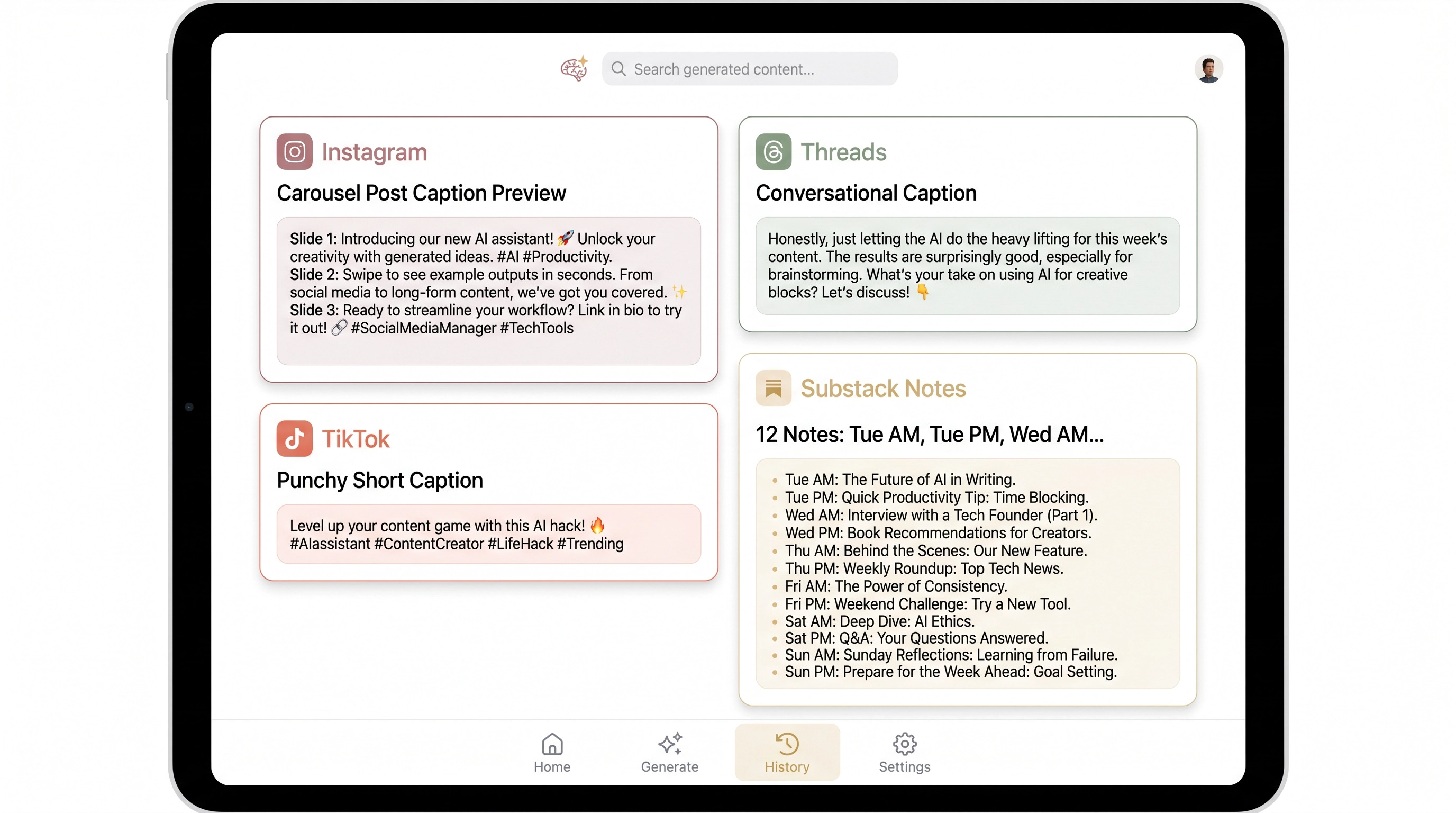
This is where Manus really saves me. Because after the article is written, I still need:
•12 Substack Notes (morning and evening, Tuesday through Sunday)
•An Instagram carousel or single image post
•Captions for Instagram, Facebook, Threads, and TikTok
•A Story teaser
•A first comment for Instagram
Before Manus, this would take me an entire day. Now? Manus drafts everything based on the article. Same voice. Same themes. Adapted for each platform.
I review, adjust, add my touch, and schedule. Done.
[Screenshot-Stelle: Die verschiedenen Social Media Texte, die Manus erstellt hat]
Step 6: The Visuals (Yes, That Too)
Manus can also generate images. For my Substack article headers, I describe the scene I want — “a blonde woman on a Croatian balcony, coffee in hand, looking at the Adriatic, illustrated style, dusty rose and sage green palette” — and it creates options.
Are they perfect? Not always. Sometimes the AI gives my illustrated self brown hair instead of blonde. Sometimes the swan looks more like a confused duck. But it gives me a starting point, and I refine in Canva with my own fonts, my own logo, my own brand elements.
What This Actually Saves Me
Let me be specific, because vague “it saves so much time” claims help nobody:
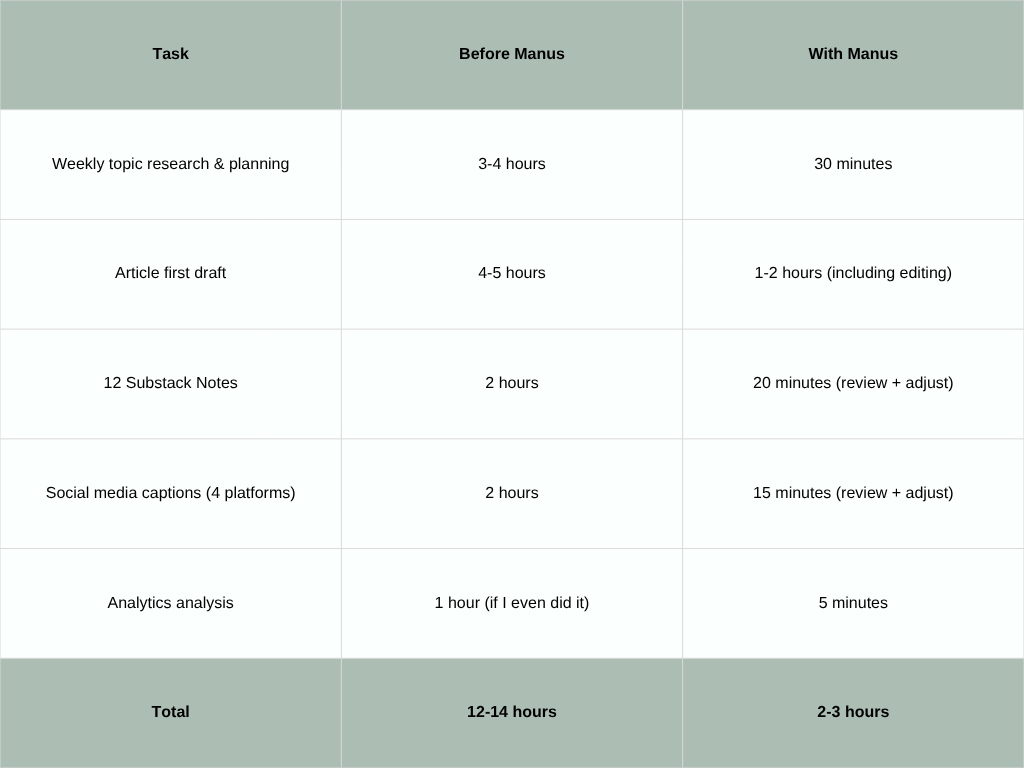
That’s not a small difference. That’s the difference between content creation being my entire week and content creation being my Tuesday morning.
The rest of the week? I work on client projects. I build systems. I drink coffee. I live.
The Part That Surprised Me Most
Here’s what I didn’t expect: Manus made me a better writer.
Not because it writes better than me. It doesn’t — not in my voice, not with my stories, not with the things that make my content mine.
But because it handles the parts I’m bad at (research, structure, platform adaptation), I have more energy for the parts I’m good at (stories, voice, connection). I’m not exhausted by the time I get to the creative part. I arrive fresh. With coffee. Ready.
It’s like having a sous chef who does all the prep work so you can focus on the actual cooking. The dish is still yours. The taste is still yours. But you didn’t have to chop the onions.
Your Move This Week
If you’ve never tried working with an AI agent (not a chatbot — an agent), here’s my challenge:
Pick one task you dread this week. Not the creative stuff. The admin stuff. The research. The planning. The “I should really organize my content calendar but I’d rather reorganize my spice drawer” stuff.
Give it to an AI agent. See what happens.
And then tell me: What did you get back? Was it useful? Did it surprise you?
I genuinely want to know. Reply to this email or drop a comment. Because the best part of this whole Manus experiment isn’t the time I save — it’s the conversations that come from sharing it.
Quick Drops
DeepSeek V4-Pro just dropped with a 75% discount. China’s AI lab is making serious moves. For creators, this means: more competition in the AI space = better tools = lower prices. The race is on, and we’re the ones who benefit.
Vibe coding is officially a thing. A career coach with zero coding experience built a passive income app using AI tools. Business Insider covered it. The barrier between “I have an idea” and “I have a product” has never been thinner.
Next week on The Drop: How I built a complete lead and applicant system for a staffing agency. With AI. And a lot of coffee. You won’t want to miss that one.
One drop. One idea. One shift.
This week’s shift: The tool is only as good as the conversation you have with it.
Until next Tuesday,
Anita
BabicADesigns — Where soul meets system.
P.S. — Want to see what’s possible when you combine AI tools with real strategy? Check out my PromptPower Deluxe — because the best AI in the world still needs a human who knows what to ask.