

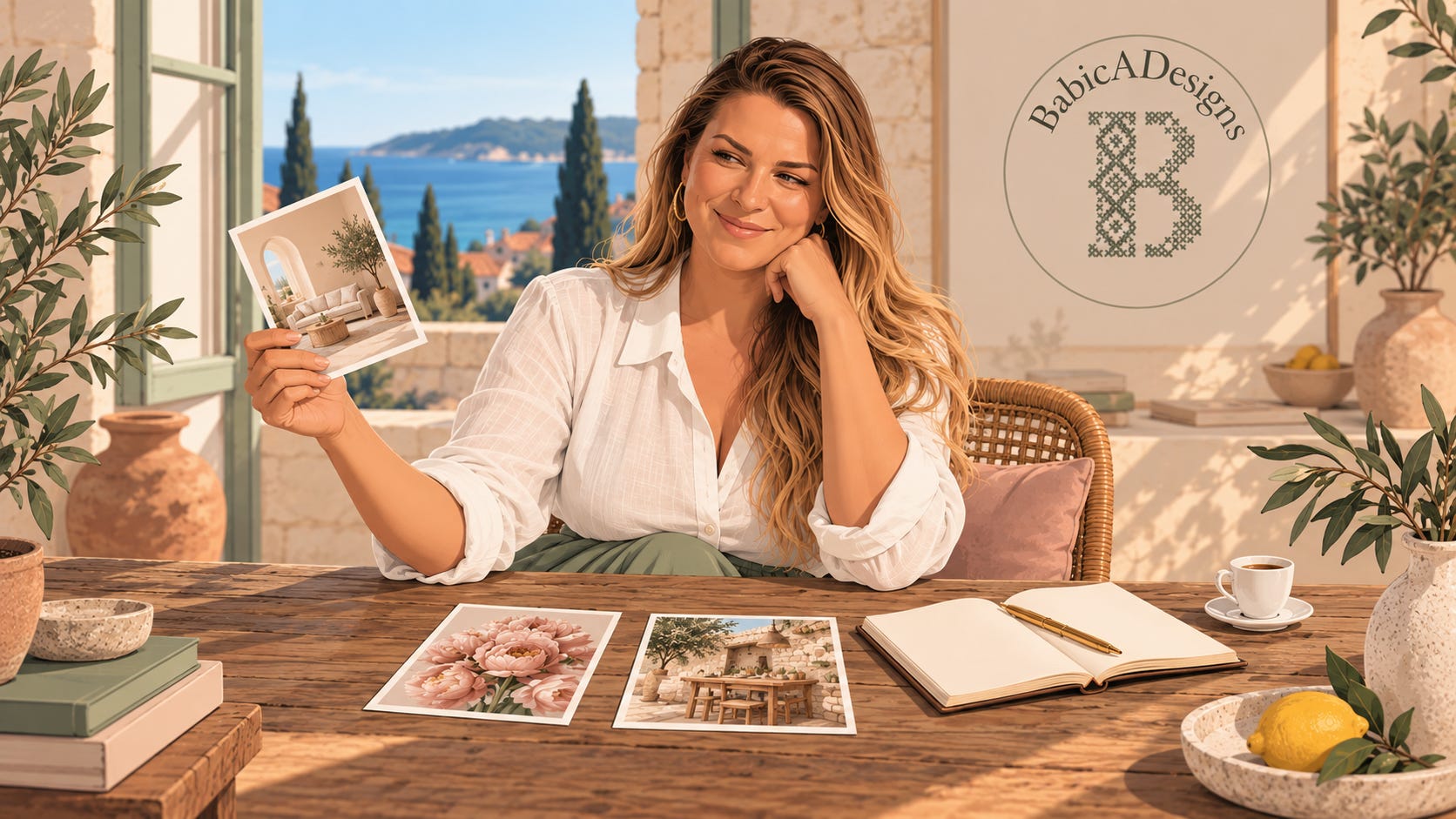
You open your image tool.
You type the words we have all typed at least once:
Kava je na stolu — and so is every new post. Subscribe free for AI strategy, brand voice, and a Balkan perspective on building something that actually sounds like you.
Warm. Editorial. Authentic. Premium. Soulful. Mediterranean, maybe. But not too Mediterranean. Clean, but with character.
A few seconds later, there it is.
It is not bad. That would almost be easier.
It is beautiful enough. The light is good. The colours are good. There is probably a rattan chair somewhere. A linen shirt. A very calm lemon. Everyone has survived.
And still, something in you says: No.
Not because the image is ugly. Because it could belong to anyone.
That is the part nobody mentions when they hand you another “perfect image prompt.” The problem is not always that the AI misunderstood the assignment. Sometimes it understood exactly what you said. You just did not give it anything that could only have come from you.
The difference between beautiful and yours
I read a piece this week by the designer Anshu Chimala about using AI in creative work. He ran the same broad landing-page prompt through four AI instances. Different details, same feeling. Purple-ish gradient. Text on the left, graphic on the right. You know the one.
Then he told the AI to be random. To be original. To surprise him. Still: variations of what the machine already knew was safe.
AI’s version of original is usually a slightly more interesting version of familiar. That is not a flaw. That is what it does.
The results only moved when he started reacting to the work. Not with “make it better,” but with actual preferences. More of this. Less of that. Not this colour. Not that energy. This feels too polished. This feels like a startup that says “we are reimagining the future of wellness” and then sells you a candle for 89 euros.
That reaction is not the boring part before the final image. That reaction is the creative work.
Your AI does not need a bigger moodboard
It needs a more honest no.
Most of us are good at collecting things we like. A hotel in Puglia. A magazine spread. A chair. Someone’s kitchen. A colour we saw once in a tiny shop in Lisbon. A campaign that made us stop scrolling.
Keep doing that. But a moodboard is mostly a record of what caught your eye. Your taste becomes useful the moment you can name what does not belong. Not because it is bad. Because it is not yours.
Maybe you love clean design, but not when it turns cold.
Maybe you like feminine visuals, but not when they turn sugary.
Maybe you want warmth, but not “AI-generated woman holding a coffee in a perfect beige kitchen” warmth. Ma daj. We have enough of those now.
Your no is not negativity. It is information. It shows you where your work stops trying to look good and starts telling the truth.
Try this: make an Anti-Moodboard
Not a big project. Not a new Notion dashboard. We are not doing that to ourselves today.
Open a note and call it: Beautiful, but not mine.
Take one thing you want to create. A cover image, a carousel, a visual for your next offer. Then ask your AI tool for three different creative directions. Not the final image yet. Directions.
You can use this:
I want to explore three distinct visual directions for [what you are creating].

My starting points are:
- [a personal memory, place, or object]
- [a texture, colour, material, or atmosphere]
- [one unexpected cultural or visual reference]

Create three separate directions. Do not make them safe or generic.
For each direction, describe the mood, visual language, colour feeling, and one surprising detail.
Do not generate the final image yet. Help me choose a direction first.
Now the actual exercise. For each direction, write three short lines:
Beautiful, but not mine because…
The part I want more of is…
Please never do that again because…
Do not overthink it. You are collecting evidence, not writing a dissertation.
Maybe one version is too polished. Maybe one feels like your old brand. Maybe one has exactly the right feeling and the wrong colours. Maybe one looks like it was made by someone who has never had a real conversation in a kitchen. You will know it when you see it.
Then take the best bits, including the rejections, and ask for a fourth direction.
This time your AI has something far more useful than another adjective. It has your judgment.
The fourth direction is where it gets interesting
What you are really building here is not an image. It is a sentence about your taste.
Something like:
I want my work to feel warm and lived-in, not perfectly styled.
I like references that carry a little history, but I do not want nostalgia to turn into costume.
I want the work to be feminine without asking permission to take up space.
That sentence travels. Into your next prompt. Your next Canva design. Your website. Your next “does this feel right?” moment.
It may end up being worth more than the image you make today. The image will change. Your taste, once you start noticing it, is the part that becomes a signature.
A small note before you go
AI can show you combinations you would not have found on your own. That is one of the reasons I like working with it.
But it cannot have the tiny internal flinch you have when something is almost right. It cannot know that a certain colour reminds you of summer at home. It cannot know that something is technically beautiful but too polished to be honest. It cannot know where your work becomes yours.
You have to tell it. And sometimes the clearest way to start is not with a yes. It is with a very specific, very useful no.
Try the Anti-Moodboard once this week. Then hit reply and tell me the one thing you realised you are tired of seeing. I have a few guesses. Beige leaves may be involved.
With coffee and Croatian stubbornness,
Anita
BabicADesigns
P.S. If your AI output regularly feels “fine, but not me,” the issue may be bigger than a single prompt. The AI Voice Gap is a free ten-minute diagnostic that shows you what context your AI is still missing.
Source that sparked the thought: How to turn your AI into a world-class designer, Anshu Chimala
The Soulful Tip Jar 🧡
My Substack will always remain free to read. But if this article gave you a little "aha" moment or made you smile today, or if you just want to support my work without committing to a subscription, you can leave a little something in my tip jar.